

The personal and the common come together in an ambience meant to trigger an associative response in the viewer. The uncanny touches the familiar, so as to evoke thoughts on the current social, political and environmental issues; such as the global warming, wars and war threats, the economic crisis, social stratification based on class, race, gender, or any other invention designed to prevent and/ or dismantle democracy.
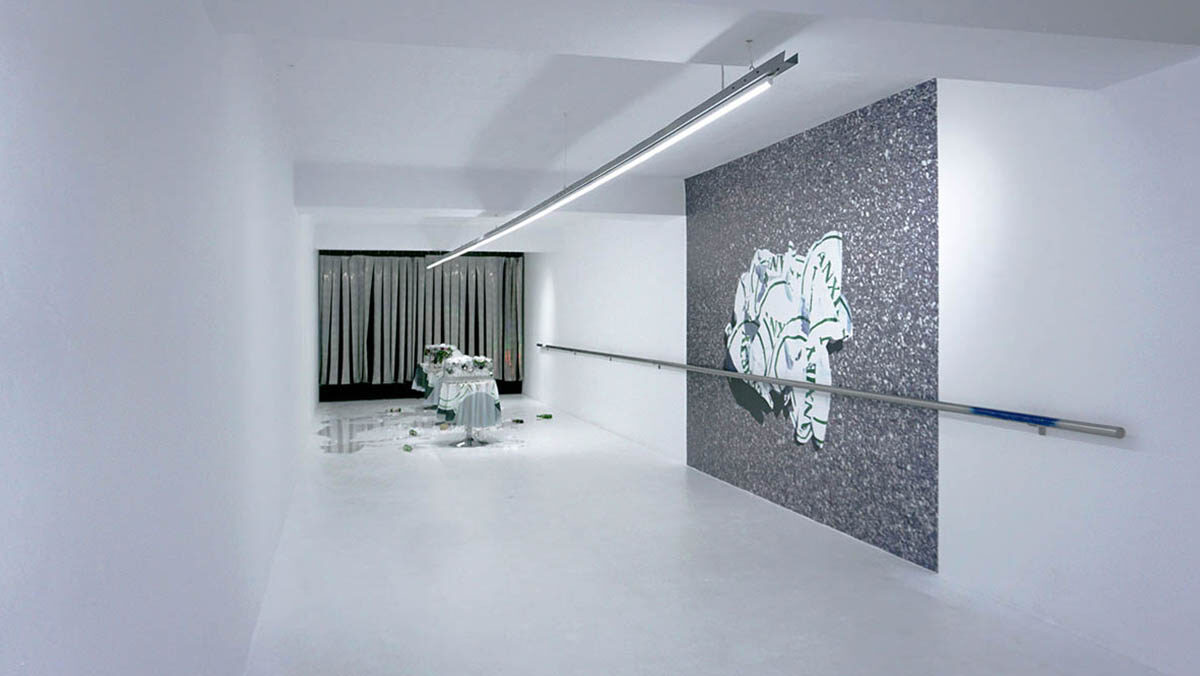
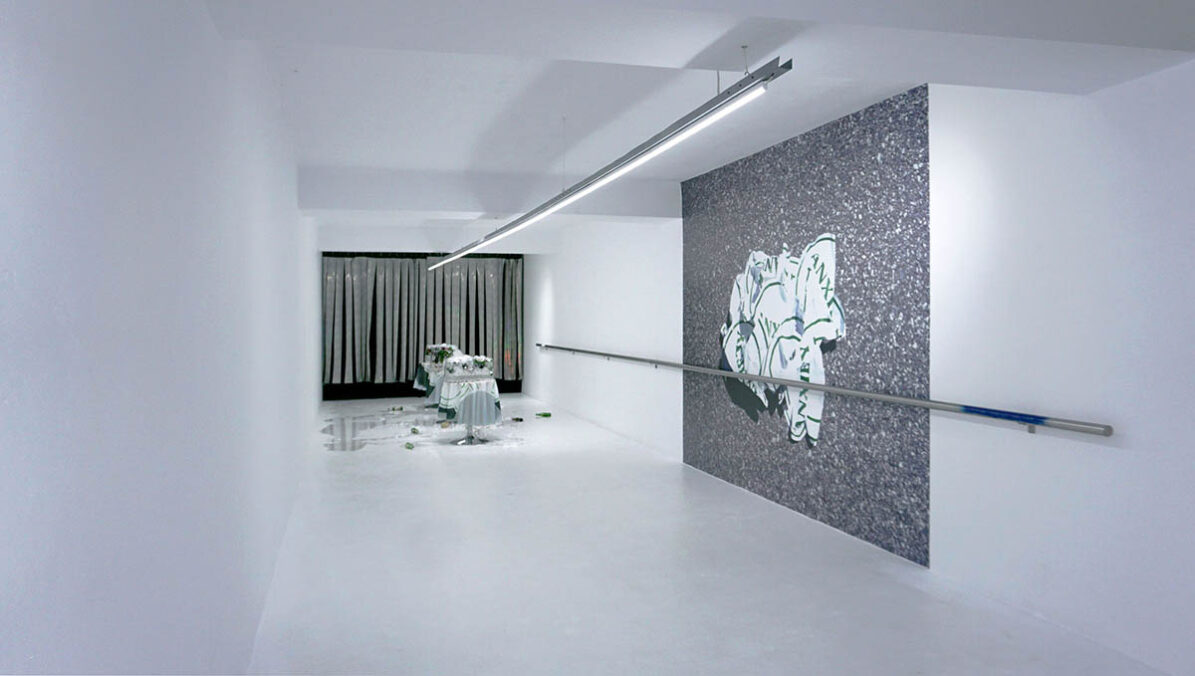
Isn’t it interesting how much content can be covered with just a few elements, though? After all, there’s only three tables with custom- printed cloths there, a wallpaper and a handrail. Buckets full of melting ice and a bunch of glass bottles, cups, cutlery, as if nobody cleaned up after a party. Whose party was it?
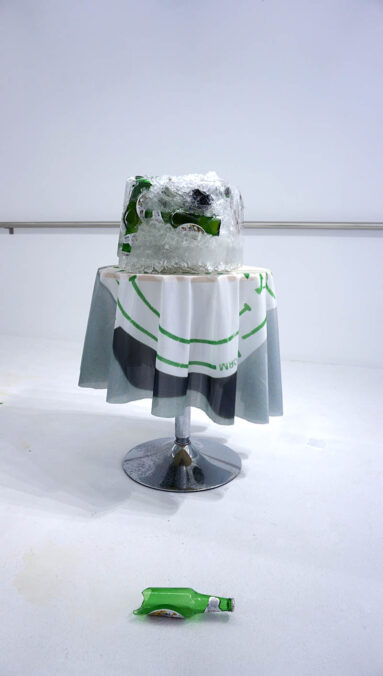
Exhibition view. Saša Tkačenko at Galeria e Bregdetit, Vlore, Albania, 2022 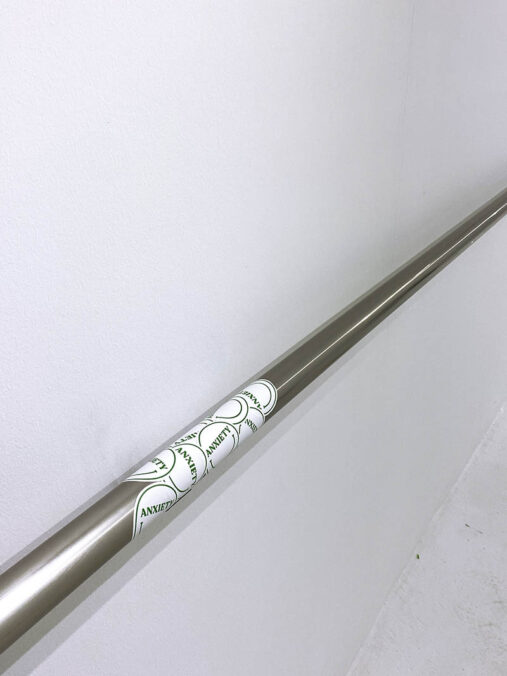
Exhibition view. Saša Tkačenko at Galeria e Bregdetit, Vlore, Albania, 2022
In my head, there’s a slightly distant, but somehow also very vivid memory of Anna-Sophie Berger’s words, a metaphor: “I was thinking of the sink at my university classroom back then. When it got too filled up with dirty dishes – there always was a breaking point – a pile started to grow. It wasn‘t that nobody had ever done the washing up. It was the progressed state of collective neglect – each one who had not cared – that appalled people”. The state of collective neglect may refer to an atmosphere of a particular place; but in this case, it could perfectly describe the state of our entire world, or rather our dystopian, contradictory times (too perfectly for me not to re- contextualise Anna’s text for her show Time in Belgrade, from 2019).
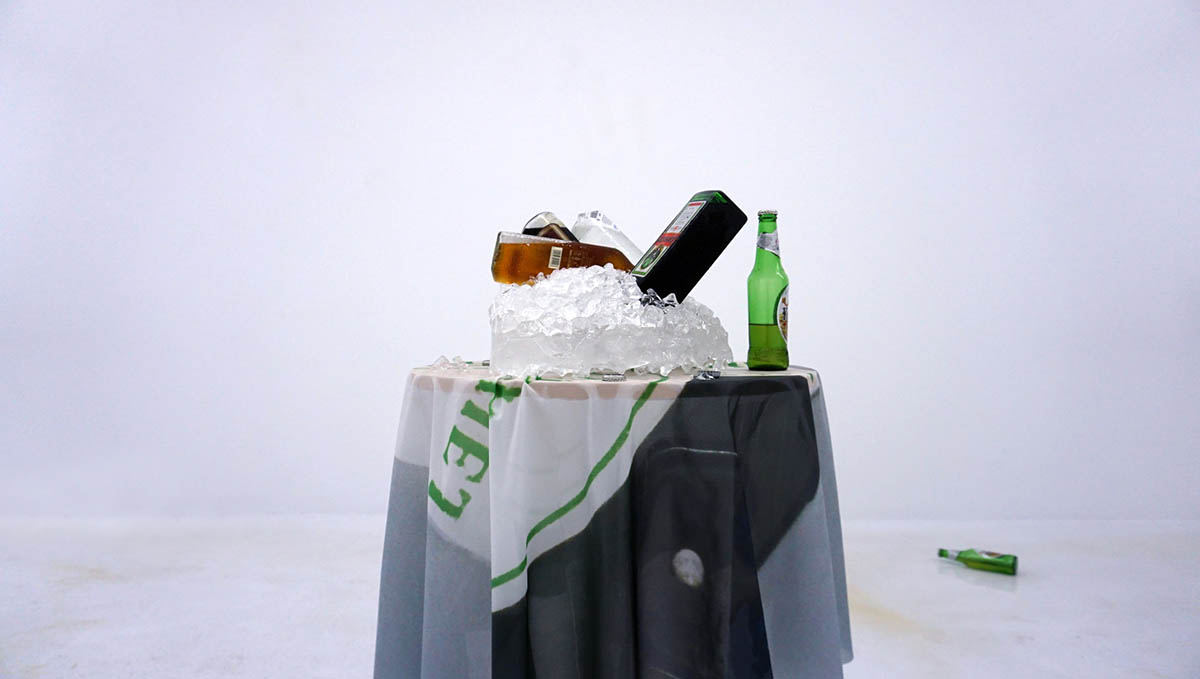
Millennials — another term of questionable geopolitical origin used for social stratification — are often described as trapped by the angst of the present moment. They, or if I abide by the categorisation then: We, strive for some kind of justice due to the naivety inherited from our parents, but we are embarrassingly still and passive before the challenges, the horrors and even the good opportunities in life. Perhaps we came to the party too late, but even so, no excuse can really eradicate the guilt, the shame and the pain that we carried in when we arrived. It is somehow as if we feel the weight of our ancestors’ crimes, violence against other people, against our own people, against humanity, against nature. I’m not sure if it’s possible to clean that up anymore.
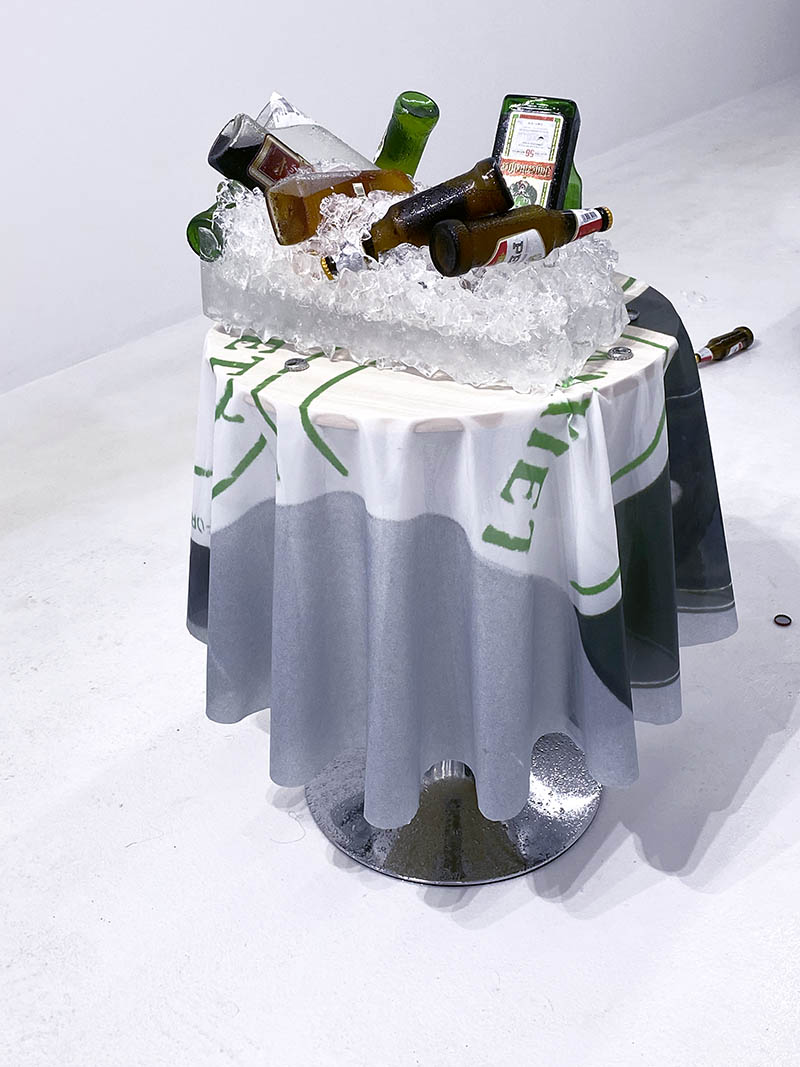
Exhibition view. Saša Tkačenko at Galeria e Bregdetit, Vlore, Albania, 2022 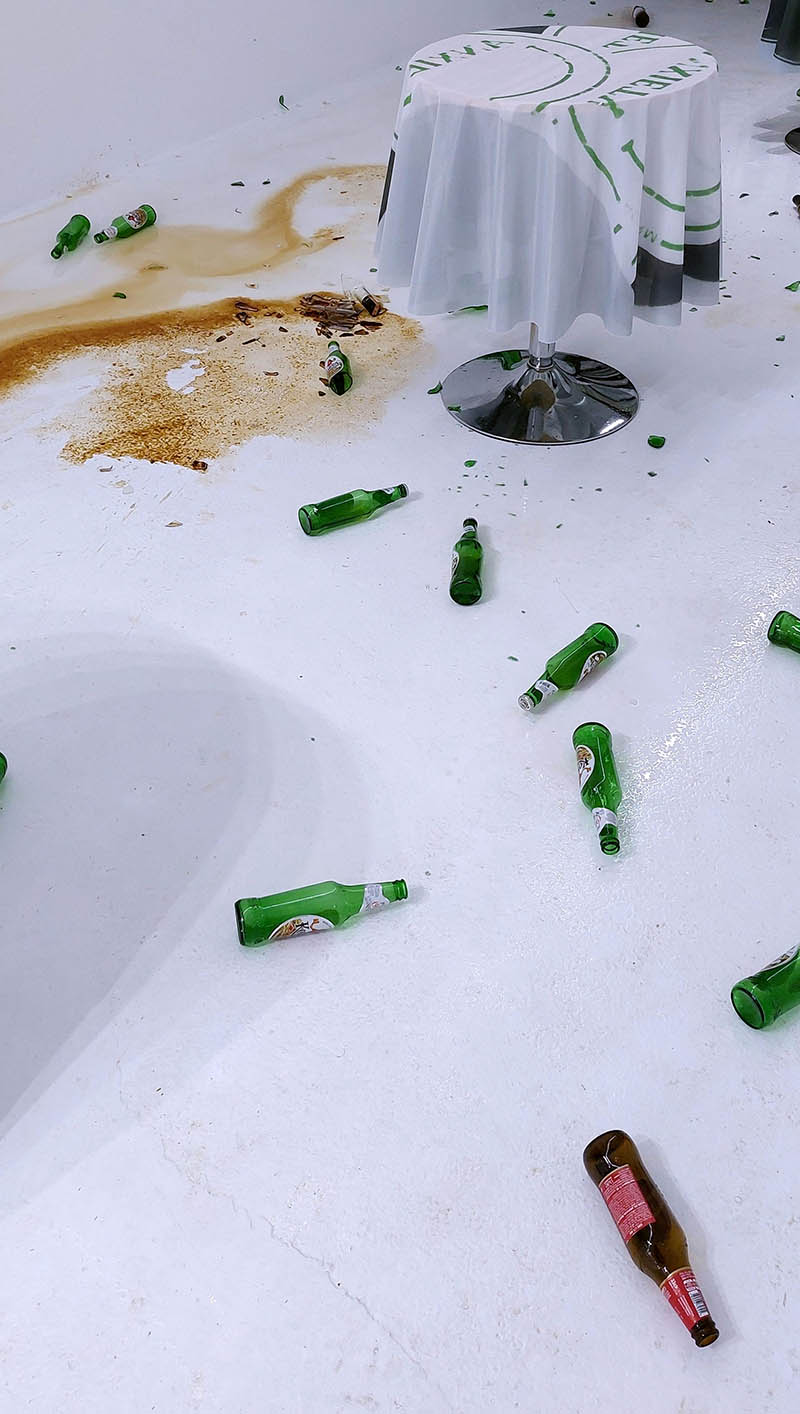
Exhibition view. Saša Tkačenko at Galeria e Bregdetit, Vlore, Albania, 2022
Saša’s assembly of familiar, utilitarian objects of no aesthetic consequence works because of where it is, and when it is. Things that we would normally not notice in a bar or in public are now playing special roles by just being what they are: places and objects for meetings and parties (and mind you, this is happening in the supposed end of a two-year-long social distancing era), places for conversations, cries and laughter, places that lure out the collective angst, that eventually goes down the drain after a night out. And the drain always leads to the sea.
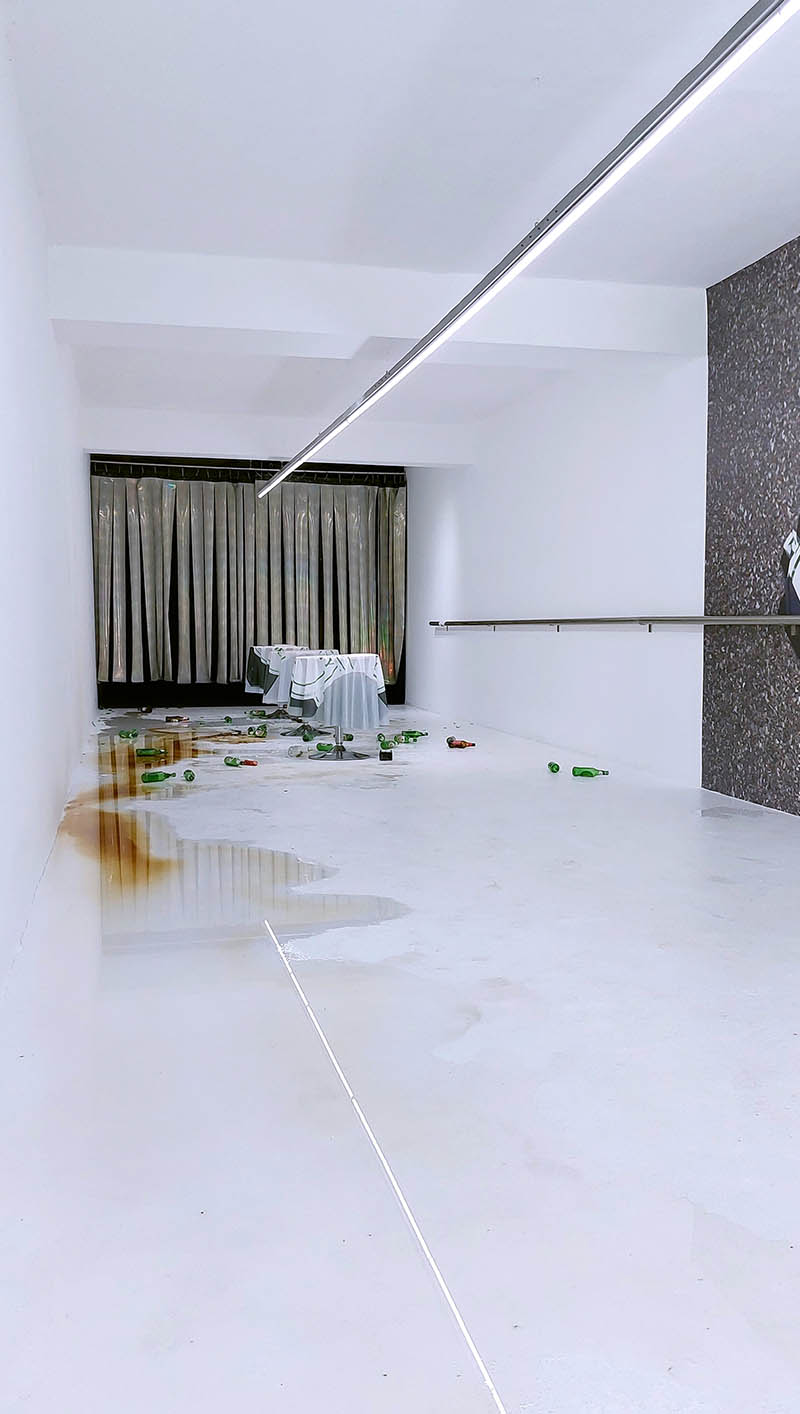
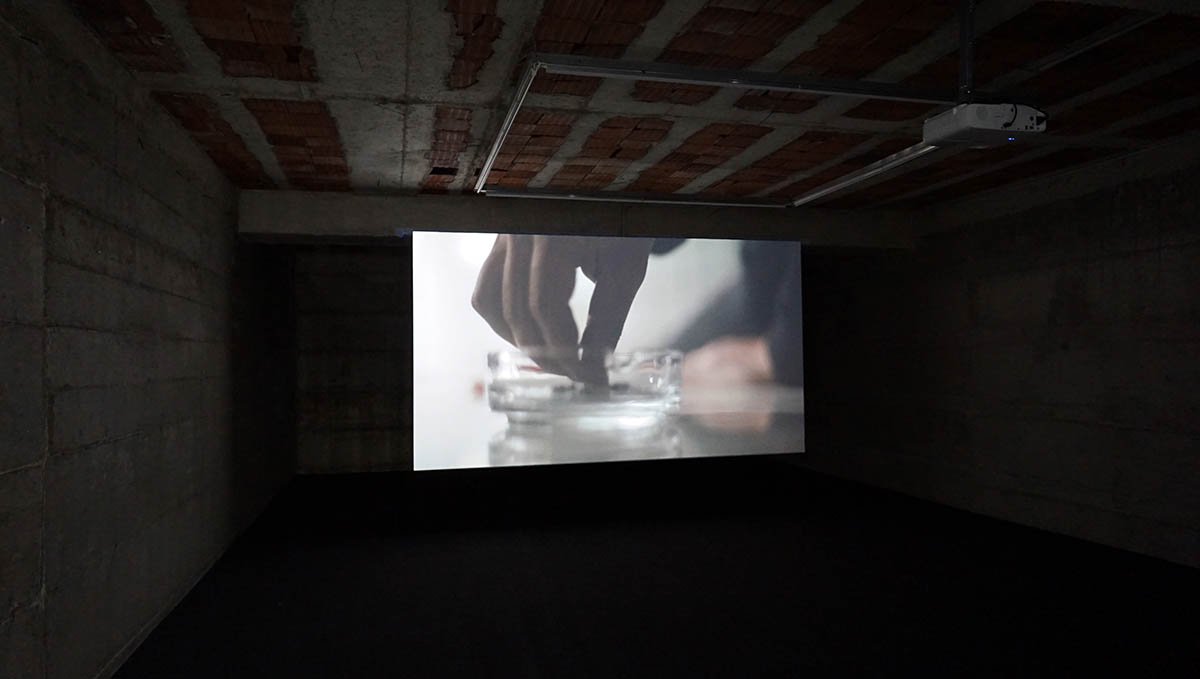
The twelve meter long handrail makes me think about holding, and holding on. There is always hope, there has to be, so the rail is long and covered in writings, stickers, someone’s memories, meaningful things that we might call sweet nothings. In the next room, to which the rail leads, is a video that recreates the imaginary atmosphere prior to an actual historical event: the assassination of the former Yugoslavian prime minister in 2003. In a sense, this spatial delegation of utilitarian objects of no aesthetic consequence might suggest Saša wants me to think that hope only leads to more waiting, or worse. However, the gallery space, although a space, has no actual end or beginning, metaphysically speaking, even if we do presume that the show linearly progresses from point A to Z. In fact, the viewer of this show is witnessing one moment where there is no time. There are only objects (of no aesthetic consequence), the video that repeats on loop, and perhaps the feelings that we’ll feel, but is there any use to talk of physical dimensions when feelings are involved? The only thing that truly indicates that time is ticking away is the ice that turns into puddles of water: dusty, muddy, inconsequential.
That thought sends me back to a guided mediation I played a few nights ago. The moon was full in Aquarius.
The pressure to participate in rituals and alternative approaches to wellbeing is too high nowadays, when what my parents would have called nonsense I embrace with a full and open heart, susceptible to magical thinking.The meditation said: You are safe. Time has stopped. You are the observer.
Exhibition: Saša Tkačenko – This mess we’re in
Exhibition duration: 19th August until 12th September 2022
Address and contact:
Galeria e Bregdetit
SH8 Vlorë-Orikum Km 8 Near Hotel Picasso Radhimë, Vlorë 9426, Albania
www.facebook.com/galeria.e.bregdetit
*The text contains a reference to Anna-Sophie Berger’s essay that accompanied her solo exhibition Time at Eugster || Belgrade in September 2019.
*The text also mentions the meditation called “Guided meditation full moon August 2022” by Alina Alive on YouTube.