

Nothing stirred in the drawing-room or in the dining-room or on the staircase. Only through the rusty hinges and swollen sea-moistened woodwork certain airs, detached from the body of the wind (the house was ramshackle after all) crept round corners and ventured indoors. Almost one might imagine them, as they entered the drawing-room questioning and wondering, toying with the flap of hanging wall-paper, asking, would it hang much longer, when would it fall? Then smoothly brushing the walls, they passed on musingly as if asking the red and yellow roses on the wall-paper whether they would fade, and questioning (gently, for there was time at their disposal) the torn letters in the wastepaper basket, the flowers, the books, all of which were now open to them and asking, Were they allies? Were they enemies? How long would they endure?
Woolf’s writing forms both a portrait of the Ramsay family in absentia and an elegant meditation on mutability. Poppy Jones’ (*1985, London) new suite of works on display in Interiors, the artist’s first solo exhibition at the gallery, performs a similar tracking over clothing, books, flowers, vases, glasses and candles. While there isn’t an overt narrative to be discerned in the 14 works there is a sense of movement, a disembodied quality of observation that gives the selection a distinctly novelistic feel. The objects in the paintings are closely cropped, caught in sunlight, or shadowed attractively, and often rendered by Jones in a single hue––each seeming to catch a quiet moment of interiority, away from the trials and tasks of the everyday. In this sense, the show’s title has a dual meaning, speaking to the way our emotional lives and domestic arrangements intertwine.
Two paintings, A Book (foreword) and A Book (Endings), bookend the exhibition. In the former, sunlight casts a tree’s shadow onto a volume resting on a windowsill. Jones’ process of lithographic printing onto suede has obscured the text on the right-hand page and only the word ‘forward’ remains distinguishable. The latter shows a blank page, the dark shadow of foliage falling across its white surface offering a kind of overwriting. Without any discernible content the images become archetypal, representing not so much a specific text as the potential of reading: the strange ways the experience can offer things beyond itself. In that sense, A Book (foreword) offers a shift into a narrative frame and Book (Endings) a shift out of one. Still lifes Ray and Glass in Daylight offer similarly liminal moments between the real and fictive. They could easily be scenes you catch looking up from a novel; the words bleeding into the room, the room into the words. Cosmos depicts the blurred head of a cosmos flower in tones of grey blue. Its silk cotton surface atomises the elements constituting the image meaning it resembles a solar eclipse; the work oscillating between petals and sky.
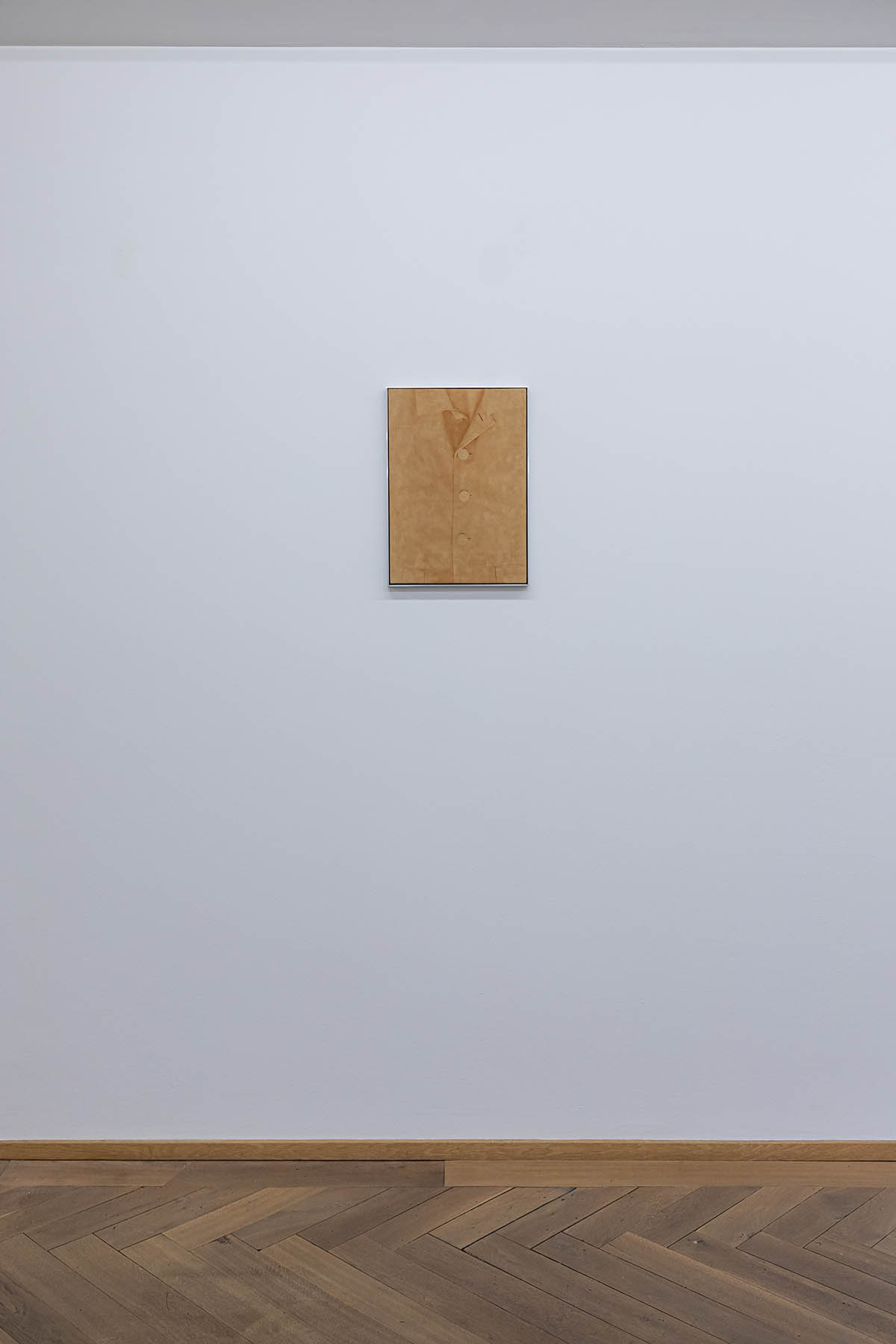
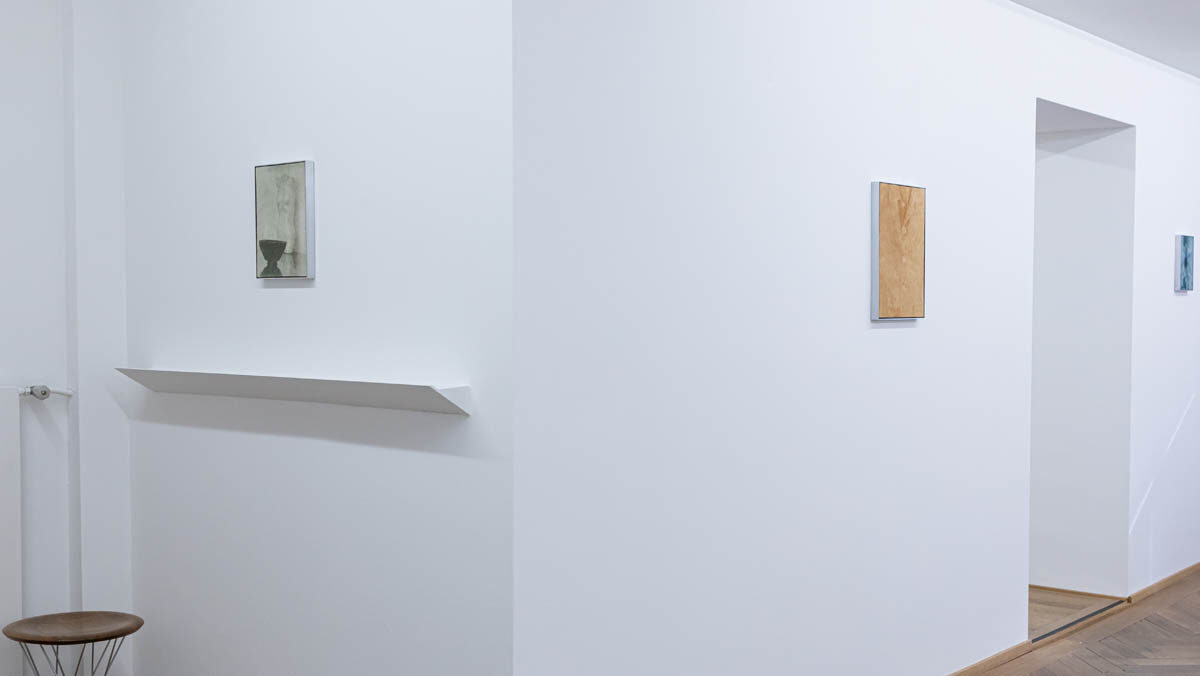
Exhibition view. Poppy Jones, Interiors 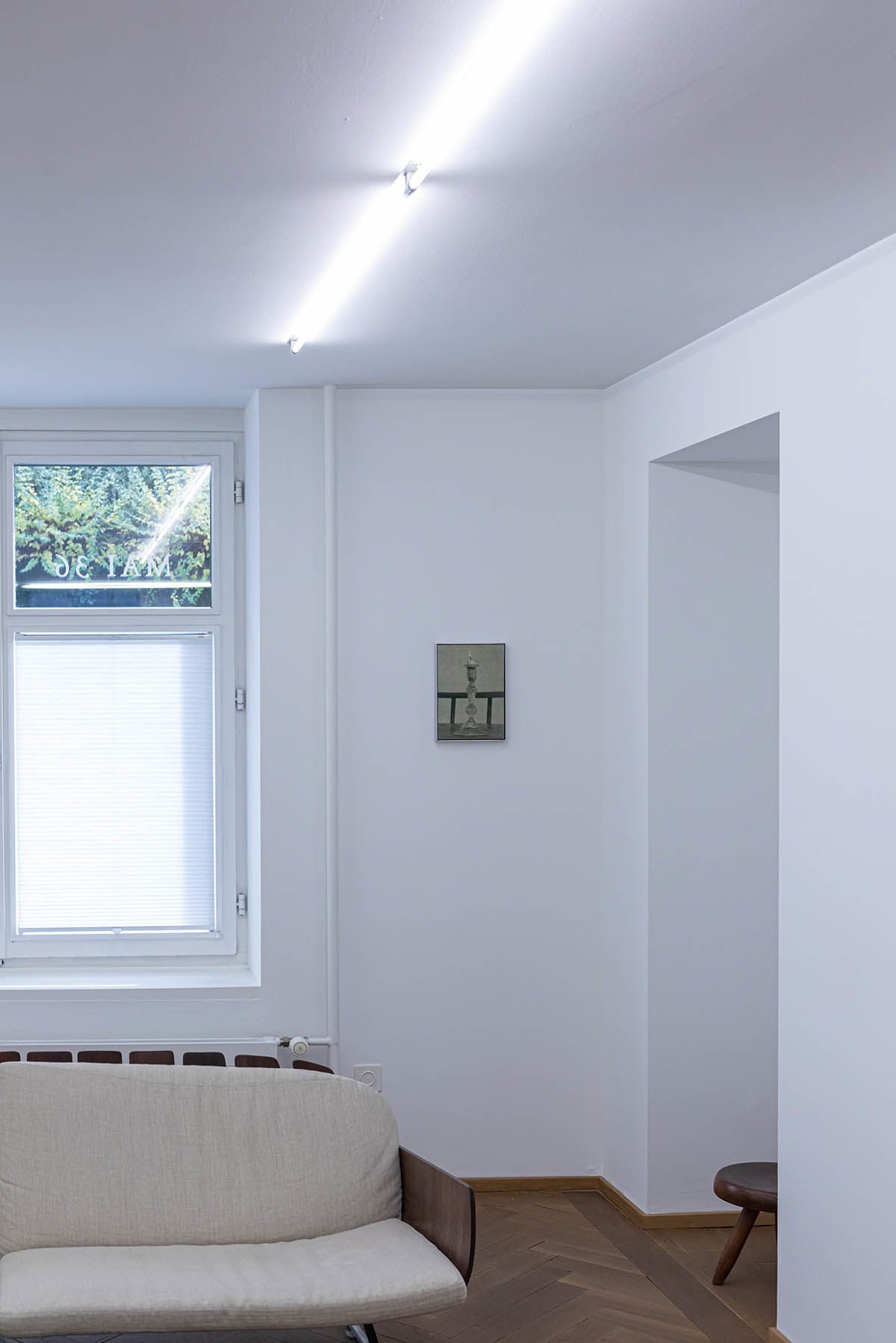
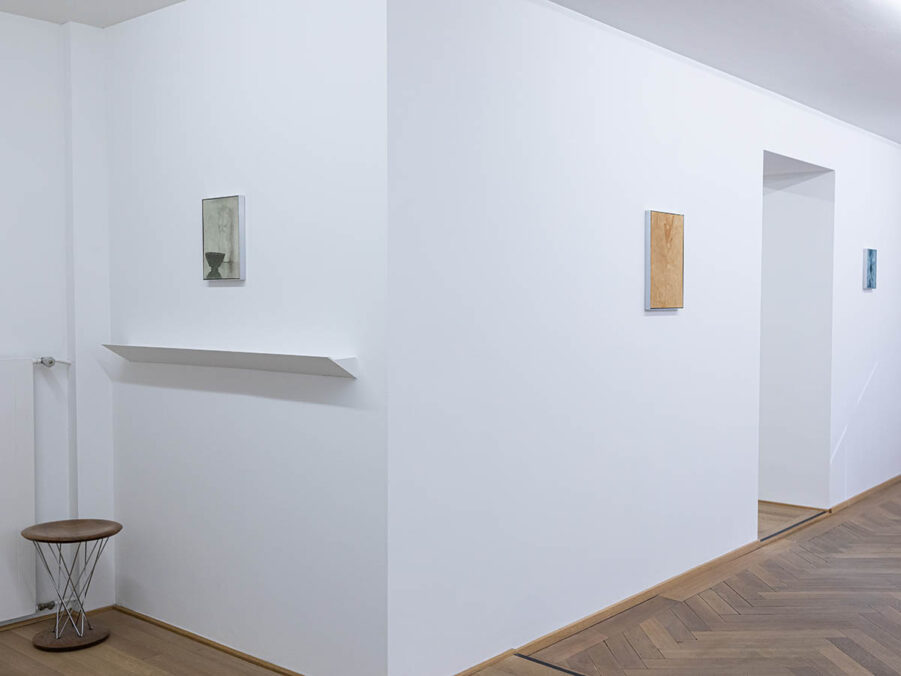
Exhibition view. Poppy Jones, Interiors
Jones previously painted a copy of Moyra Davey’s Index Cards, [title TK], a book which provides a compelling precedent for her interest in the quotidian. Index Cards is composed of a series of short diary entries where Davey begins with a thought, cultural object or everyday event and gracefully connects them to other aspects of her life, ideas, photographs and writing. Jones also offers a set of personal fragments, an abbreviated autofictional record of the culture at large. Her process is led by intuition and the paintings emerge from the artist soaking up impressions of the things that surround her and photographing them on her iPhone. Their photographic origin lends them a poignancy––they capture a time of day, the angle of a shadow, dust motes in a ray of light.
Pictures of clothes from the artist’s wardrobe are features of Interiors. Jones paints these images on silk, suede or cotton, in canvases sometimes cut from her own garments or items she has sourced online. These materials are often true to the images themselves as well as being connected to her life. The jacket in Mortal Form is Jones’ own and is painted on suede. Its surface is peppered with fingerprints and little movements of the hand; imprints implying the gestures involved in buttoning up a jacket, brushing it down, hanging it up. Jones’ painterly flourishes are indistinguishable from real signs of wear.
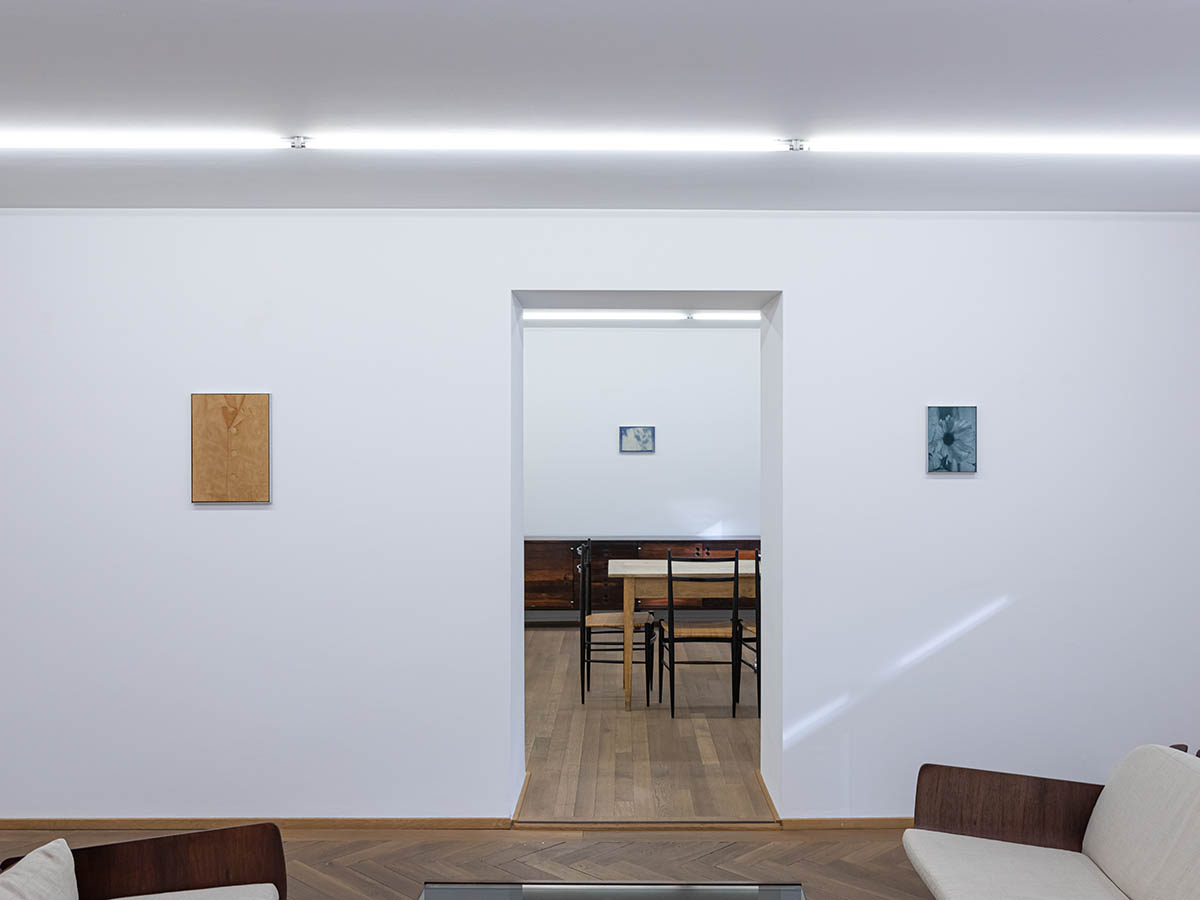
For Heat of the Day Jones employed an antique green cloth to produce an image of her own puffer jacket, literally linking her present lifestyle to material from the past. As with the reference to Davey, she is continually making connections to what other artists, writers and makers have done before, always considering their engagement with similar themes. This effort comes to the fore in Glass/Flame and Vessels which perfectly blur the biographical and fictive. Both paintings began life as photographs taken by the artist at Kettle’s Yard, a private house turned public museum in Cambridge, England. It mixes modernist art with the other trappings of a cultured life; furniture, musical instruments and books. While these domestic arrangements are from someone else’s house they also come to form part of Jones’ story.
Throughout Interiors there is a play between inside and outside and an abiding concern with points of transition; a windowsill, an open book, a zipped jacket, a lit candle, flowers drooping in a vase. The set offers a kind of incomplete inventory, a partial view, or a portrait of someone just out of shot, and also a lacuna for contemplation for ourselves. Together they represent what Virginia Woolf might recognise as the effort ‘to assemble outwardly the scattered parts of the vision within.’
Exhibition: Poppy Jones, Interiors
Exhibition duration: 11.11.2022 till 23.12.2022
Address and contact:
Mai 36 Galerie
Rämistrasse 37, 8001 Zürich, Switzerland
www.mai36.com